This appendix briefly describes the methods for calculating the future climate metrics. Where needed, citations are provided for detailed descriptions of the metrics, and where specific parameters or other inputs are used, they are described in a paragraph below the metric. For comparison between the historical and future periods, the historical (GridMET 1979-2012) climate is typically included along with the 30-year average of each climate future (MACA, 2035-2065; centered on 2050). Unless noted, all measures are reported in U.S. Customary units (Fahrenheit, inches, etc.).
Averages
Average annual, monthly, seasonal (average maximum temperature, minimum temperature, relative humidity, VPD)
For the period of interest (year, season, month), the mean of the daily values.
Average annual, monthly, seasonal precipitation
Average sum of daily precipitation for the period of analysis (month, year, etc.)
Thresholds
All thresholds are calculated as the number of events (typically days) that exceed an upper or lower threshold value. Examples are days per year over 95 °F (35 °C). Thresholds most relevant to the resources and management differ across park settings and climate zones.
Days/year over 95 °F (35 °C)
Average number of days per year when the maximum daily temperature exceeds 95 °F (35 °C)
Days/year over 95th and 99thth percentile historical temperature
Average number of days per year when the maximum daily temperature exceeds the historical 95th and 99th percentile
Consecutive days/year over 99th percentile historical temperature
Average length of consecutive days per year when the maximum daily temperature exceeds the historical 99th percentile
Days/year under 32 °F (0 °C)
Average number of days per year when the minimum daily temperature is below 32 °F (0 °C)
Days/year under 5th percentile historical temperature
Average number of days per year when the minimum daily temperature is below the historical 5th percentile
Consecutive days/year under 5th percentile historical temperature
Average length of consecutive days per year when the minimum daily temperature is below the historical 5th percentile
Days/year with precipitation
Average number of days per year when daily precipitation exceeds 0.05 inches (1.27 mm).
Consecutive days/year with precipitation
Average length of consecutive days per year when daily precipitation exceeds 0.05 inches (1.27 mm).
Days/year over 95/99thth percentile historical precipitation
Average number of days per year when precipitation amounts exceed the historical 95/99th percentile. The 95/99th percentile is calculated from days that receive greater than 0.05 inches (1.27 mm) precipitation.
Days/year over 1 and 2 inch precipitation
Average number of days per year when precipitation amounts exceed 1 and 2 inches (25.4 and 50.8 mm).
Freeze-thaw cycles
Average number of freeze-thaw cycles per year, measured as days where the maximum temperature >34 °F (1 °C) and the minimum temperature <28 °F (-2 °C). (Fraser 1959).
Wet-frost cycles
Average number wet-frost cycles per year, measured as days when precipitation exceeds 0.079 inches (2 mm) and average temperature exceeds 32 °F (0 °C) followed immediately by a day when average temperature is below 30.2 °F (-1 °C) (Sabbioni et al. 2010).
Growing season length
The following metrics are calculated as they are defined by CLIMDEX (https://www.climdex.org/learn/indices/)
Growing-degree days
Sum of the difference of the average daily temperature and 41 °F (5 °C) for those days when the average daily temperature exceeds 41 °F (5 °C).
Growing season length
Average growing season length, measured in days: the number of days between the start of the first spell of warm days in the first half of the year, and the start of the first spell of cold days in the second half of the year. A spell of warm days is defined as six or more days with mean temperature above 41 °F (5 °C); a spell of cold days is defined as six or more days with a mean temperature below 41 °F (5 °C).
First green-up day
Average green-up date, measured as the start of the first spell of warm days in the first half of the year. A spell of warm days is defined as six or more days with mean temperature above 41 °F (5 °C).
End growing season
Average end of growing season, measured as the first spell of cold days in the second half of the year. A spell of cold days is defined as six or more days with average temperature below 41 °F (5 °C).
Late spring frost events
Late spring frost events, calculated as days with minimum temperatures equal to or below 32 °F (0 ° C) after the green-up date (see definition above), but before the summer solstice.
Dangerous heat index days
Average number of days per year when the heat index exceeds the ‘dangerous’ threshold (103°F; OSHA 2019)
The base heat index equation is (NWS 2014):

where
T = temperature in degrees F
Rh = relative humidity in percent
If Rh <13% and 80 °F < T<112 °F, adjustment 1 should be subtracted from heat index

If Rh >85% and 80 °F <T <87 °F, adjustment 2 should be added to heat index

The heat index is assumed to be a measure of instantaneous heat stress from current conditions. However, because available downscaled climate data are only available at daily temporal resolution, we calculate heat index using daily maximum temperature and minimum relative humidity because temperature and relative humidity have an inverse relationship (i.e., the warmest part of the day has the lowest relative humidity; Bonan 2015).
Extreme caution heat index days
Average number of days per year when the heat index exceeds the ‘dangerous’ threshold (90°F; OSHA 2019)
Water balance modeling
Metrics of temperature and precipitation alone fail to account for interactive aspects of climate, soils, and topography that affect water availability for plants and ecosystem processes. Water balance modeling accounts for the interaction of these factors to estimate ecological water availability through time. We used a simple water balance model (Thoma et al., 2020, Tercek et al., 2021) with site-specific parameters (location, elevation, slope, aspect, soils) and meteorological variables from climate futures to evaluate water-related implications of climate changes.
The water balance model partitions precipitation into rain or snow. An adjustment factor, based on relative humidity, was used to account for observed differences in snow dynamics in arid and moist climates (Jennings et al., 2018). Rain and snow melt contribute to soil moisture (water stored in the top meter of soil). Precipitation that exceeds soil storage capacity becomes runoff. Potential evapotranspiration (PET), calculated via the Oudin method (Oudin et al., 2005), is the amount of water that could be evaporated and transpired from a short grass with available energy and unlimited water. This relatively simple method relies on data available for all U.S. parks, and it has been evaluated and used for many park studies (Thoma et al. 2020, Tercek et al. 2023). Actual evapotranspiration (AET), the loss of water from soil via evaporation and transpiration, is limited by soil moisture. Climatic water deficit is the amount of additional water vegetation would use if available, calculated as the difference between PET and AET (Stephenson 1998, Thoma et al. 2020). For site-specific locations with high winds, or where humidity is consistently high, a more complex model that accounts for these variables may provide a somewhat different result.
Key water balance variables are:
Potential evapotranspiration (PET)
Water that could be evaporated and transpired from short grass prairie with unlimited water. Calculated on a daily timestep using the Oudin et al. (2005) equation.
Actual evapotranspiration (AET)
Loss of water from evaporation and transpiration, limited by soil moisture (i.e., by actual water availability).
Climatic water deficit (CWD)
The amount of additional water vegetation would use if available, or an estimation of unmet water need. CWD is calculated as the daily difference between PET and AET.
Soil moisture
The amount of water left in the top meter of soil after precipitation inputs and evaporative outputs, with soil water holding capacity values from the U.S. Natural Resources Conservation Service (Soil Survey Staff, Natural Resources Conservation Service, USDA 2019, Tercek et al. 2021)
Runoff
Runoff is calculated as the surplus water from the soil layer, i.e., when daily inputs–outputs exceeded water holding capacity.
Snow water equivalent (SWE)
Amount of snow, as a water equivalent (versus actual snow depth) is estimated using equations from Tercek and Rodman (2016) with temperature coefficients for those equations provided by Jennings et al. (2018).
Extreme events
Characterizing Drought
Standardized Precipitation-Evapotranspiration Index
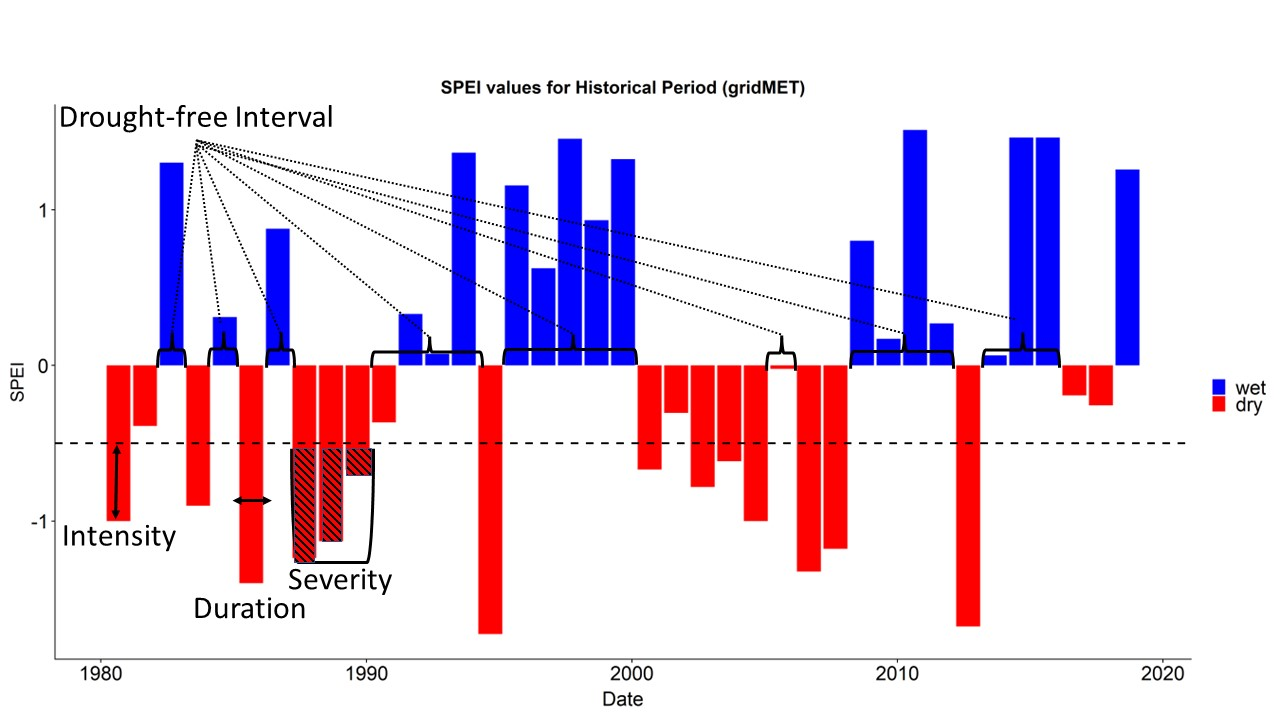
Standardized Precipitation–Evapotranspiration Index (SPEI) was used to capture characteristics of drought periods. SPEI is a drought index, based on precipitation and potential evapotranspiration (PET), that is used to identify periods that are wetter and drier than average in a given location (Vicente-Serrano and National Center for Atmospheric Research Staff 2015). SPEI is useful when accounting for climate change because it includes temperature effects on evapotranspiration. Monthly SPEI is summarized on a rolling 6-month period (SPEI-6) to represent accumulated drought conditions over an ecologically relevant timescale.
Drought characteristics
CCRP used the R package “SPEI” (Vicente-Serrano
et al. 2010, Beguería
and Vicente-Serrano 2017) to calculate the indicator
and characterized four aspects of a drought event:
duration, severity, intensity, and return interval (see Figure
4). An SPEI value below -0.5 indicates a “drought”,
signifying drier than average conditions (Shiau
and Shen 2001). A drought event begins when SPEI
falls below the threshold and lasts until SPEI returns
above the threshold (Figure
4).
Extreme Precipitation
24-hour precipitation recurrence intervals
Multiple approaches can be used to estimate potential changes in extreme conditions. Two approaches commonly used are threshold exceedances (frequency of extreme events, characterized by metrics described above) and block maxima (magnitude of event; Katz 2010, Cooley et al. 2019). Tabari (2021) uses the block maxima approach from gridded climate data for both historical and future periods, stating that “extreme value theory shows that block maxima extremes can be approximated most accurately using the generalized extreme value (GEV) distribution.”
The goal of extreme value statistics is often extrapolation (e.g., estimating the magnitude of a 100-year event when only 50 years of data are present). Because extreme events are rare, estimation methods can result in large uncertainties associated with estimated quantities (Cooley et al. 2019). To mitigate these issues, we modeled return periods out to 100 years by fitting the full period of record for the historical period (1979-2012) and future period (2020-2099) to the GEV distribution so that future records required less extrapolation.
The return period is the average time between events and is often used for risk analysis. We calculated return levels following a method similar to those described by Van Dusen et al. (2020).
-
Extract the annual maximum daily precipitation values (block maxima) for the historical period and each climate future and rank the events by magnitude;
-
Estimate the best GEV distribution for each time period by fitting the data to GEV using the R package extRemes (Gilleland and Katz 2016). The shape parameters, location (µ), scale (σ) and shape (ε) are estimated using maximum likelihood and shift as a function of precipitation.

where
z = precipitation
ε = shape
µ = location
σ = scale
-
Calculate the return period of a quantile z using:

Where
T = return period in years
From this we have estimates of 1- to 100-year precipitation events and can extract changes in magnitude of a given return as well as how frequently (the probability) that precipitation of a particular magnitude will occur in a given year. One criticism of using block maxima approaches for estimating future climate change is that it cannot account for multiple extreme events that occur close to one another (e.g., first and second highest daily precipitation events occurring in the same year). Peaks-over-threshold methods are an alternative approach, accounting for all events over a given threshold, which can be applied when a given threshold is known (Tabari 2021).